Every compliance team has a story about the one analyst whose memory caught a suspicious pattern — and a dozen stories about the times nobody caught it at all. The SAR Narrative Copilot, built by Siorik Consultancy under the Risk Simplifier brand, exists so that your next filing never depends on a single person’s recall. This is the story of why we built it, what it does, and why it matters to every MLRO, analyst, and FIU team wrestling with alert fatigue and narrative inconsistency.
◆
The Problem: Human Memory Is Not a Compliance Control
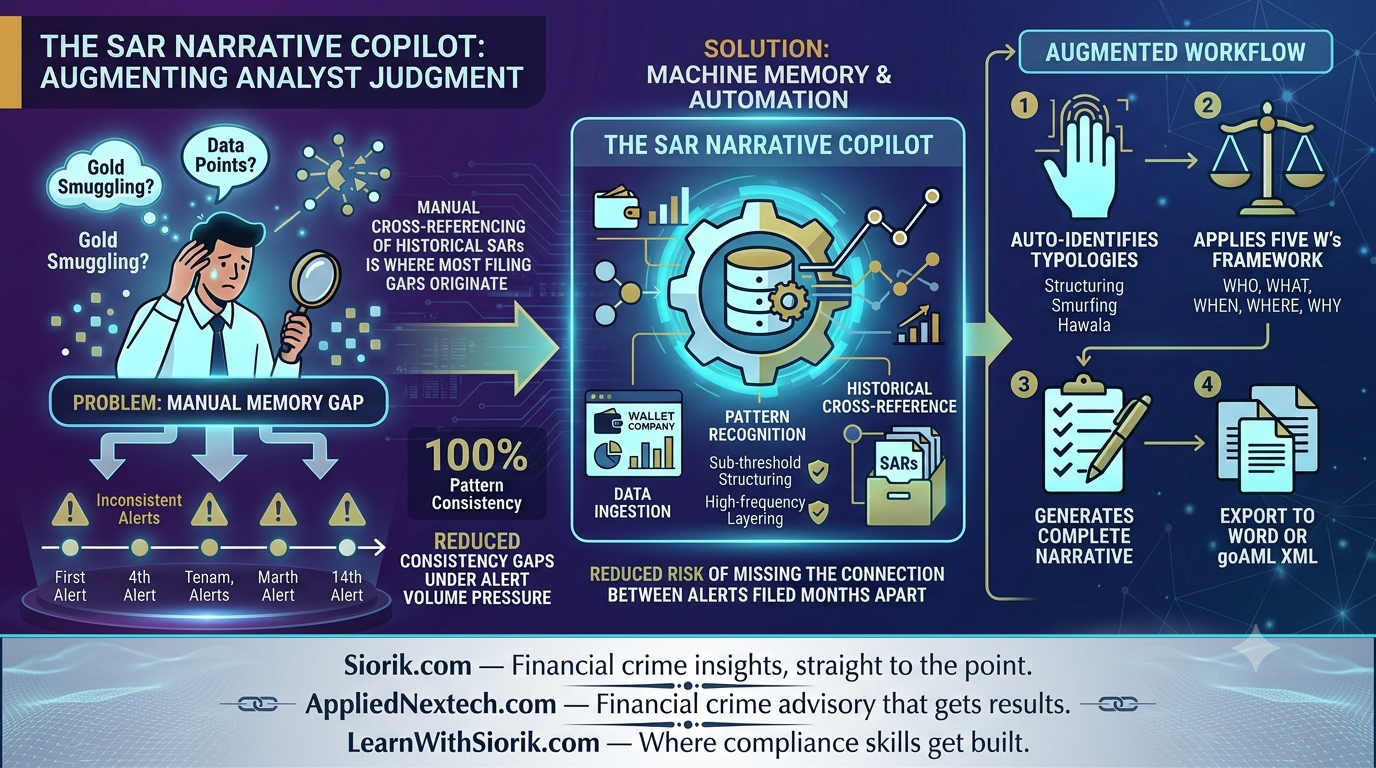
Picture this: an AML analyst in a mid-sized bank reviews 200+ alerts every day. She has to cross-reference new transactions against months — sometimes years — of historical Suspicious Transaction Reports (STRs). She needs to spot structuring, smurfing, and sub-threshold deposit patterns across multiple accounts, currencies, and counterparties. And then she must write a clear, consistent, audit-ready SAR narrative before moving to the next case.
Now multiply that across a team. Analysts rotate, take leave, resign. Institutional knowledge walks out the door. The result?
- Missed filings — structuring patterns slip through because no one remembers the related STR filed six months ago.
- Inconsistent narratives — two analysts describe the same typology in completely different ways, creating audit risk.
- Regulatory exposure — regulators expect timely, complete, and well-structured SARs. Falling short triggers enforcement.
Relying on individual analyst memory as your primary control for detecting recurring subjects or linked typologies is a systemic vulnerability — not a process. Regulators increasingly view it as a control gap, especially in jurisdictions adopting risk-based supervision.
The Real Case That Sparked the Build
The SAR Narrative Copilot wasn’t born from a product roadmap. It was born from a real investigation.
During an AML review at a financial institution in Nepal, a single analyst noticed something unsettling in a wallet company’s settlement account: a series of cash deposits, each just below the reporting threshold, spread across multiple days. Individually, they were unremarkable. Together, they pointed to structuring — a classic technique used to evade transaction reporting requirements.
Deeper investigation revealed links to a gold smuggling and Hawala (Hundi) racket. The case was ultimately filed as an STR. But the critical question lingered: what if that particular analyst hadn’t been on shift that day?
“One analyst’s memory caught the Nepal gold smuggling case. The SAR Narrative Copilot exists to ensure the next investigation never depends on memory alone.”— Siorik Consultancy, Risk Simplifier
That case became the design benchmark. Every feature in the copilot was tested against this scenario: Would the tool have caught it? Would it have flagged the history? Would the narrative have been regulator-ready? The answer had to be yes on every count.
◆
What the SAR Narrative Copilot Actually Does
The copilot is not a chatbot that generates vague summaries. It is a purpose-built AI drafting and analytics engine for AML/CFT compliance, designed to sit alongside human analysts — augmenting judgment, never replacing it.
End-to-End Workflow: From CSV Upload to goAML Submission
Upload a CSV of transaction records. The tool instantly parses amounts, dates, counterparties, and account identifiers.
AI algorithms flag deposits and transfers that cluster just below reporting thresholds — the hallmark of structuring and smurfing.
The copilot automatically checks whether any subject in the current dataset has appeared in previously filed STRs — and flags the match with full context.
Using the Five W’s framework (Who, What, When, Where, Why), the AI produces a complete, formal STR narrative in regulatory language.
Download a polished Word (.docx) document for MLRO review, or export directly to goAML XML format for FIU submission — particularly optimized for FIU-Nepal workflows.
The copilot automatically identifies typologies — structuring, Hundi/Hawala, high-frequency transfers, round-tripping — from raw data. Analysts no longer need to manually tag patterns before drafting. The AI surfaces them, and the human confirms or overrides.
Traditional SAR Drafting vs. AI-Assisted Drafting
Understanding the shift requires a direct comparison. Here’s how the copilot changes the day-to-day reality for compliance teams:
Use the AI-generated narrative as a first draft, not the final submission. The MLRO should always review, refine, and approve. The copilot ensures nothing is missed; the compliance officer ensures nothing is misrepresented. That division of labor is the sweet spot.
The Evolution: From Manual Compliance to AI-Augmented Intelligence
The SAR Narrative Copilot didn’t emerge in isolation. It sits at the convergence of two decades of regulatory tightening and rapid advancements in applied AI for compliance.
2003 – goAML Introduced by UNODC
The UN Office on Drugs and Crime launched goAML as a standardised platform for FIUs worldwide, creating a common submission framework that Nepal and dozens of other jurisdictions adopted.
2012–2018 – Global Enforcement Surge
Record-breaking AML fines highlighted narrative quality failures. Regulators began scrutinising not just whether SARs were filed, but how well they were written and how quickly they were submitted.
2020–2023 – RegTech & NLP Maturation
Natural language processing reached the sophistication needed to generate structured regulatory narratives. Compliance-specific AI tools moved from concept to production.
2024–Present – SAR Narrative Copilot Launch
Siorik Consultancy releases the copilot, purpose-built for real typologies, real regulatory requirements, and real analyst workflows — starting with Nepal’s FIU and goAML ecosystem.
◆
Who Is the SAR Narrative Copilot For?
The tool is designed for professionals who live in the space between transaction data and regulatory submission:
- MLROs and Deputy MLROs — who need consistent, reviewable SAR drafts without bottlenecking the team.
- AML/CFT analysts — who need pattern detection support across hundreds of daily alerts.
- Financial Intelligence Units (FIUs) — who receive and review STR filings and benefit from structured, high-quality submissions.
- RegTech professionals and compliance consultants — who advise institutions on technology-driven compliance transformation.
- Nepal-regulated entities — particularly those filing to FIU-Nepal via goAML, where the XML export feature provides immediate operational value.
Frequently Asked Questions
◆
Conclusion: AI Isn’t Replacing Compliance Professionals — It’s Giving Them Superpowers
The SAR Narrative Copilot was built on a simple conviction: the most dangerous gap in AML compliance isn’t a lack of rules — it’s the space between what an analyst should remember and what they can remember across thousands of cases, day after day, year after year.
This tool closes that gap. It remembers every prior filing, catches every sub-threshold cluster, and drafts every narrative with the same rigour — whether it’s the first SAR of the morning or the fiftieth. Built on real typologies, real regulatory requirements, and real workflows, it transforms the compliance function from reactive documentation to proactive intelligence.
Need Expert AML/CFT & RegTech Guidance?
17+ years across FATF, CBUAE, VARA & NRB. Visit our website for consultancy services tailored to your organization.
“Your compliance programme looks good on paper.
But will it survive a regulatory examination?”