How AI Reads Your Passport Better Than a Bank Teller: NLP-Driven KYC Document Analysis and Fraudulent Document Detection
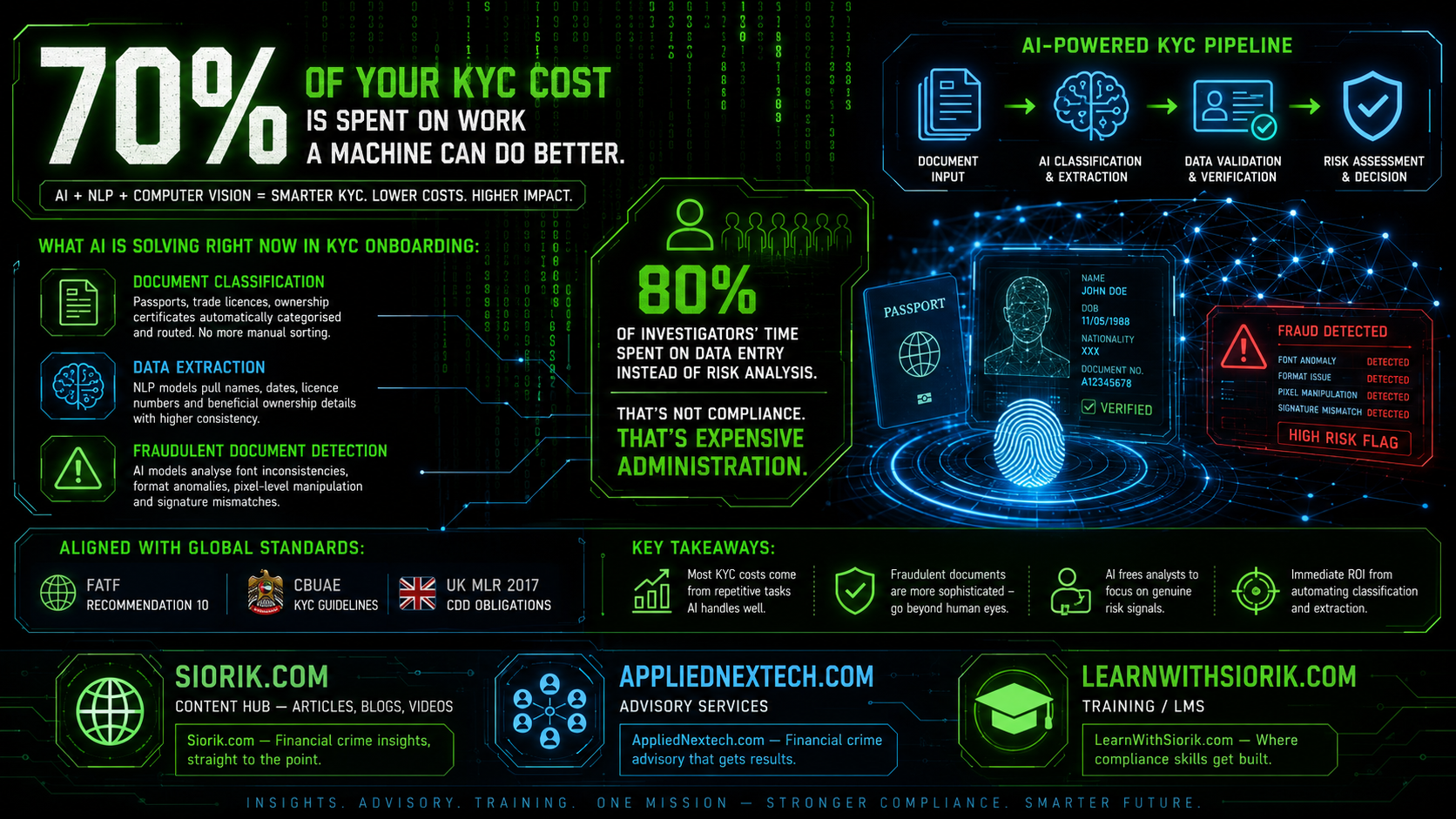
Customer onboarding remains one of the most resource-draining functions in financial crime compliance. An estimated 70% of Customer Due Diligence (CDD) costs are consumed by repetitive, manual document review — analysts squinting at passports, cross-referencing trade licences, and manually keying data into case management systems. But a quiet revolution is underway. Natural Language Processing (NLP), paired with computer vision, is transforming how institutions classify, extract, verify, and — critically — detect fraud in KYC documentation. This article explores the technology, the regulatory context, the ROI case, and the practical steps compliance teams need to take today.
◆
The Burden of Manual KYC Document Review
Every new customer relationship begins with documents. Passports, national IDs, utility bills, corporate registrations, beneficial ownership certificates, and — in trade finance — bills of lading and letters of credit. Analysts must verify that documents are authentic, extract key data fields (name, date of birth, address, entity identifiers), and match them against sanctions lists and internal records.
The sheer volume is staggering. A mid-size bank onboarding 50,000 retail customers and 5,000 corporate clients annually may process over 200,000 individual documents per year — each requiring human eyes, human judgment, and human data entry.
The consequences extend beyond cost. Slow onboarding frustrates customers, increases abandonment rates, and diverts skilled analysts from genuinely complex, risk-based decisions to mechanical data entry. Worse still, fatigued human reviewers miss subtle forgery indicators — the exact vulnerabilities that criminal networks exploit.
A 2023 industry study found that human reviewers correctly identified fraudulent identity documents only 65–75% of the time when under production-line time pressure. Sophisticated forgeries — particularly digitally altered PDFs and AI-generated face-swapped passport photos — slip through at alarming rates.
◆
How NLP and Computer Vision Transform Document Analysis
NLP-driven KYC document analysis isn’t a single technology — it’s a pipeline of interconnected AI capabilities that work in sequence to replicate (and surpass) what a trained analyst does.
The Core Pipeline
Convolutional neural networks (CNNs) and vision transformers instantly classify uploaded files — distinguishing a UAE Emirates ID from a UK driving licence, a commercial invoice from a certificate of incorporation. This eliminates manual sorting entirely.
Optical Character Recognition (OCR) digitises text, while NLP models parse structured and unstructured fields — extracting names, dates, addresses, and licence numbers. Named Entity Recognition (NER) handles multilingual documents, crucial in jurisdictions like the UAE where Arabic and English coexist.
NLP compares extracted data across multiple submitted documents — does the name on the passport match the trade licence? Does the registered address on the utility bill align with the corporate filing? Fuzzy matching algorithms handle transliteration variations (e.g., “Mohammed” vs. “Muhammad”).
This is where the technology truly excels. Computer vision models analyse font consistency, pixel-level alterations, metadata tampering, EXIF data anomalies, MRZ (Machine Readable Zone) checksum validation, and signature verification against known specimen databases.
Each document receives a confidence score and risk rating. Clean documents flow through to auto-population of the CDD profile. Suspicious documents are flagged with specific fraud indicators for analyst review — transforming the analyst’s role from data entry to expert adjudication.
The real power of NLP in KYC isn’t just speed — it’s consistency. Unlike a human analyst at 4:55 PM on a Friday, an NLP model applies the same rigour to the 10,000th document as it does to the first. This consistency is precisely what regulators expect under a risk-based approach.
Detecting Fraudulent Documents: What AI Actually Sees
Let’s get specific. How does an NLP and computer vision system detect a forged passport or a doctored trade licence? Here are the primary detection vectors:
- Font inconsistency analysis: Genuine government-issued documents use specific, often proprietary fonts. AI models trained on thousands of authentic specimens detect when a character is rendered in a different typeface — even if the visual difference is imperceptible to the human eye.
- Format and template matching: Every country’s passport, every UAE free zone’s trade licence, follows a precise layout. Deviations in spacing, field positioning, or logo placement trigger alerts.
- MRZ checksum validation: The machine-readable zone on passports contains mathematical checksums. A single altered digit causes a checksum failure — instantly detectable.
- Metadata forensics: A passport scan should not contain Adobe Photoshop in its EXIF metadata. NLP models parse file metadata for editing software signatures, unusual creation timestamps, and GPS coordinates inconsistent with the claimed origin.
- Signature and photo integrity: Deep learning models compare submitted photos against known biometric markers and detect GAN-generated (deepfake) face images through artefact analysis.
“The document doesn’t lie — but the forger leaves fingerprints in the pixels. AI’s job is to find them before the relationship is established.”— Senior Compliance Technology Officer, Top 10 MENA Bank
Regulatory Alignment: FATF, CBUAE, and UK MLR 2017
The adoption of NLP-driven document analysis doesn’t occur in a regulatory vacuum. The technology directly supports obligations under three critical frameworks:
When deploying NLP-driven document analysis, maintain a human-in-the-loop for all cases flagged as high risk or where the model’s confidence score falls below your validated threshold. Regulators in both the UAE and UK expect that technology augments — not replaces — qualified human judgment, particularly for Enhanced Due Diligence.
The Evolution of Document Verification Technology
2005–2010: Basic OCR
First-generation OCR tools could read printed text from scanned documents but struggled with handwriting, poor image quality, and non-Latin scripts. Error rates above 15% meant extensive manual correction.
2011–2017: Machine Learning Classification
Supervised ML models enabled automatic document classification. Banks could auto-sort incoming documents by type, reducing initial triage time by 40–60%.
2018–2022: Deep Learning + NLP Integration
Transformer-based NLP models (BERT, GPT variants) enabled semantic understanding of document contents. Multilingual NER made cross-border KYC feasible at scale. Fraud detection accuracy exceeded 90%.
2023–Present: Multimodal AI & Real-Time Verification
Vision-language models process text, images, and layout simultaneously. Real-time API integrations with government databases enable instant verification against source registries. GAN-detection models combat deepfake identity documents.
◆
Practical Implementation: Where to Start
For compliance leaders evaluating NLP-driven document analysis, the path to deployment isn’t all-or-nothing. The highest-ROI starting point is typically retail onboarding identity verification — high volume, standardised documents, well-defined fraud patterns. Corporate KYC and trade finance follow as second and third phases, given their greater document complexity.
Key implementation considerations include:
- Model validation and governance: Before deployment, validate the model against a representative sample of your institution’s document types, languages, and fraud scenarios. Document the validation methodology — regulators will ask.
- Explainability: Ensure the system can articulate why a document was flagged. “The font in the date-of-birth field does not match the expected typeface for a UAE Emirates ID issued after 2019” is auditable. A black-box score is not.
- Data privacy: KYC documents contain highly sensitive personal data. Ensure processing complies with the UAE’s PDPL, UK GDPR, and any applicable sectoral data protection requirements.
- Continuous monitoring: Fraud techniques evolve. Retrain models quarterly using newly detected fraud samples and emerging document formats.
The ROI case is compelling: institutions deploying NLP-driven KYC document analysis report 50–80% reduction in document processing time, 30–40% reduction in CDD operating costs, and — most critically — a measurable improvement in fraud detection rates. The technology pays for itself within the first onboarding cycle at scale.
Frequently Asked Questions
◆
Conclusion: The Competitive and Compliance Imperative
NLP-driven KYC document analysis is no longer experimental. It is a mature, deployable capability that addresses the dual pressures every compliance function faces: doing more with less, and catching what humans miss. When 70% of your CDD budget is consumed by tasks a machine can perform faster, more consistently, and more accurately, the question is not whether to adopt — it’s how quickly.
The institutions that move first will benefit from faster onboarding, lower operational costs, superior fraud detection, and — perhaps most importantly — the ability to redeploy skilled compliance professionals toward the genuinely complex, judgment-intensive work that only humans can do.
Start with a defined pilot scope, validate rigorously, maintain human oversight, and build a comprehensive audit trail. The technology is ready. Your regulators are watching. Your competitors are already moving. The time to act is now.
Need Expert AML/CFT & RegTech Guidance?
17+ years across FATF, CBUAE, VARA & NRB. Visit our website for consultancy services tailored to your organization.
“Your compliance programme looks good on paper.
But will it survive a regulatory examination?”