
AML/CFT Program Gap Assessment: A Step-by-Step Methodology That Produces Actionable Findings
Every regulated financial institution conducts some form of AML/CFT gap assessment. Yet a striking number of those exercises culminate in a tidy spreadsheet of “missing policies” that earns a polite nod from internal audit — and then fails spectacularly under regulatory examination. The reason is deceptively simple: most gap assessments confuse the existence of a document with the effectiveness of a control. This article provides a rigorous, replicable methodology for conducting gap assessments that surface real deficiencies, assign genuine accountability, and produce remediation evidence that regulators, correspondents, and boards can rely on.
“Compliance failures must be identified, escalated, and remediated in a timely manner, with evidence of board-level awareness.”— Wolfsberg Group, Compliance Effectiveness Guidance
◆
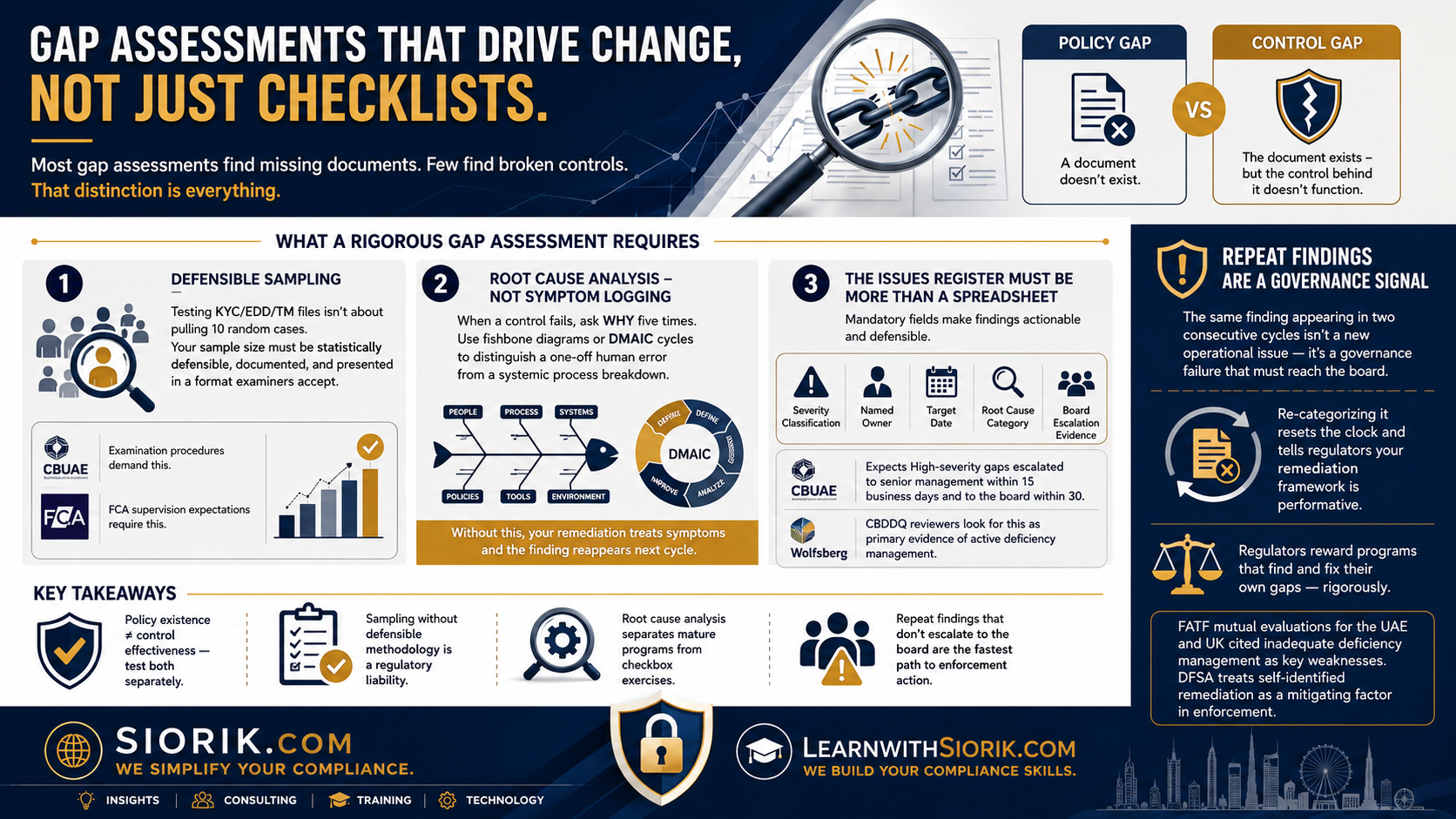
1. The Critical Distinction: Policy Gaps vs. Control Gaps
Before a single file is sampled, the assessment team must internalise a distinction that determines whether the entire exercise will be useful or performative.
- Policy gap: The required document, procedure, or standard simply does not exist. Example: no written Enhanced Due Diligence (EDD) procedure for PEPs despite a regulatory obligation under UAE Cabinet Decision No. 10 of 2019, Article 16.
- Control gap: The policy exists, but the control it mandates is not functioning — or is not functioning consistently. Example: the EDD procedure exists and is Board-approved, but 40 % of sampled PEP files show no evidence that the mandated source-of-wealth corroboration was performed.
Confusing these two categories produces assessments that satisfy internal auditors — who check for policy existence — but not regulators, who test for control effectiveness. The FATF mutual evaluation report for the UAE (2020) and the UK (2018) both cited inadequate deficiency management systems as key weaknesses, driven in part by this very confusion.
2. The Step-by-Step Gap Assessment Methodology
A defensible gap assessment is not a checklist exercise — it is a structured programme of work with defined phases, sampling logic, and documentation standards. Here is the methodology we recommend, aligned with CBUAE Examination Procedures, FCA SUP 10C, and FATF Recommendation 18(b).
Map every applicable regulatory obligation (UAE AML Law, MLR 2017, FATF standards) to internal policies. This creates a completeness matrix — every obligation must trace to at least one policy and one operational control.
For each mapped obligation, confirm the policy exists, is Board-approved, is version-controlled, and has been reviewed within the required cycle (typically 12–18 months). Missing or stale policies are logged as policy gaps.
Sample KYC, EDD, and TM files to test whether controls documented in policy are actually operating. This is the step most institutions either skip or perform inadequately. See sampling methodology below.
For every control gap identified, conduct root cause analysis using fishbone diagrams and the DMAIC cycle. Distinguish random human errors from systemic process breakdowns — the remediation differs drastically.
Log all findings in a structured Issues Register with mandatory fields and clear escalation timelines. This is the deliverable that regulators, correspondent banks, and the Board will scrutinise.
3. Sampling Methodology: Getting It Right for Examiners
The credibility of your gap assessment stands or falls on your sampling approach. A sample that is too small or non-representative will be dismissed by regulators; a sample that is overly large wastes resources without improving confidence levels.
Defensible Sample Size Selection
For populations under 500 files, regulatory examiners in the UAE and UK typically apply a rule-of-thumb: test the greater of 30 files or 10% of the population per control area. For larger populations, use a confidence-level approach — 95% confidence with a 5% margin of error is the industry-accepted standard for AML file reviews. Critically, stratify your sample by risk tier: ensure high-risk customers (PEPs, high-risk jurisdictions, complex structures) are over-represented relative to their proportion in the portfolio.
Documentation Standards for Sampling
Every sampled file must be documented with: file reference, date reviewed, reviewer name, control attribute tested, pass/fail result, and notes on exceptions. This documentation is not optional — it is what transforms a gap assessment from an opinion into evidence. When an FCA examiner asks “how did you arrive at this finding?”, you should be able to hand them the testing workpaper within minutes.
Present sampling findings as exception rates rather than binary pass/fail. For example: “23% of sampled EDD files lacked documented source-of-wealth verification” is far more actionable than “EDD control — FAIL.” Exception rates enable trend analysis across assessment cycles and demonstrate analytical rigour to examiners.
◆
4. Root Cause Analysis: Moving Beyond “Staff Didn’t Follow the Procedure”
Identifying a control gap is only half the job. The critical question is why the control failed — and most assessments answer this question with a lazy, circular statement: “staff did not follow the procedure.” That is a symptom, not a root cause.
Fishbone Diagram for AML Control Gaps
Apply the Ishikawa (fishbone) diagram across six categories: People (training adequacy, staffing levels), Process (unclear procedures, handoff failures), Technology (system limitations, alert calibration), Data (incomplete or stale data sources), Management (oversight gaps, tone from the top), and External (regulatory change not yet incorporated). This structured decomposition almost always reveals that what appeared to be individual non-compliance is actually a systemic process or technology failure.
Applying the DMAIC Cycle
For systemic control gaps, apply the DMAIC cycle — Define the specific control objective that is not being met; Measure the exception rate through your sampling; Analyse root causes using the fishbone; Improve by redesigning the control (not merely re-training staff); and Control by establishing ongoing monitoring metrics. This approach, borrowed from Six Sigma, brings the rigour that distinguishes a compliance programme from a compliance theatre.
If your root cause analysis consistently concludes “training gap” for diverse control failures across different teams, your root cause analysis itself has a root cause problem. Training is rarely the primary cause — it is the easiest cause to claim because re-training is the cheapest remediation. Dig deeper into process design, system constraints, and workload distribution.
5. The Issues Register: Your Single Most Important Compliance Artefact
The Issues Register is not a nice-to-have tracking tool — it is arguably the single most scrutinised artefact during regulatory examinations, correspondent banking due diligence (Wolfsberg CBDDQ), and Board compliance reporting. The CBUAE AML/CFT Standards Section 12 and the UK’s JMLSG Part I Chapter 7.5 both mandate documented deficiency registers with specific attributes.
Mandatory Fields
- Finding reference number — unique, sequential, never recycled
- Severity classification — High / Medium / Low with defined criteria
- Finding description — precise, citing the specific regulatory obligation breached
- Root cause category — aligned with the fishbone taxonomy
- Named owner — a specific individual, not a department
- Target remediation date — realistic, agreed with the owner
- Remediation evidence required — pre-defined, measurable proof of closure
- Board escalation evidence — date reported to senior management and Board
- Status — Open / In Progress / Closed (with verification)
Escalation Timeline Requirements
Day 0 — Finding Identified
Control gap documented with severity classification, root cause, and named owner assigned. Entered into the Issues Register immediately.
Day 5 (High Severity) — Senior Management Escalation
CBUAE expects High-severity findings escalated to senior management within 5 business days. FCA SUP 10C similarly requires the MLRO to formally report material control failures.
Day 15–30 (High Severity) — Board Escalation
Within 15 business days per CBUAE standards (30 days maximum). Board minutes must reflect awareness, discussion, and direction. This evidence is specifically requested during examinations.
Ongoing — Remediation Tracking & Closure Verification
Monthly reporting to senior management, quarterly to the Board. Closure requires independent verification — the finding owner cannot self-certify closure. The DFSA Enforcement Principles (2021) note that adequacy of self-identified remediation is a mitigating factor in enforcement proceedings.
6. Repeat Findings: The Governance Red Flag You Cannot Ignore
Here is a rule that separates mature compliance programmes from immature ones: if the same finding appears in two consecutive assessment cycles, it must be escalated to the Board as a governance failure — not re-categorised as a new operational finding with a new reference number and a reset remediation clock.
Repeat findings signal one of three systemic problems: the root cause analysis was wrong, the remediation was inadequate, or senior management failed to allocate sufficient resources. All three are governance failures.
The FCA’s “Dear CEO” letters (2019, 2021) explicitly state that failure to maintain a documented deficiency management process — including tracking repeat findings — is itself a regulatory finding. Regulators view recycled findings as evidence that your governance framework is not merely weak but fundamentally non-functional.
Tag every Issues Register entry with a “Prior Finding” field. When a new finding matches a prior entry, automatically elevate its severity by one level (Medium → High) and trigger a mandatory Board escalation. This mechanism should be hard-coded into your Issues Register workflow — not left to the discretion of the assessment team.
◆