Most candidates I’ve interviewed had the certificate. Very few could actually do the job.
I’ve spent more than twenty years in financial crime compliance, across banks and financial institutions in Nepal and the UAE. Over that time I’ve sat on the other side of the table for more interviews than I can count — AML analysts, KYC officers, transaction monitoring specialists, the occasional team lead. And after two decades of this, one pattern has become impossible to ignore.
Almost every strong résumé looks the same. CAMS. ICA. Sometimes both. Years of “compliance experience” listed neatly under Professional Experience. On paper, these candidates look ready.
Then I ask them a simple question.
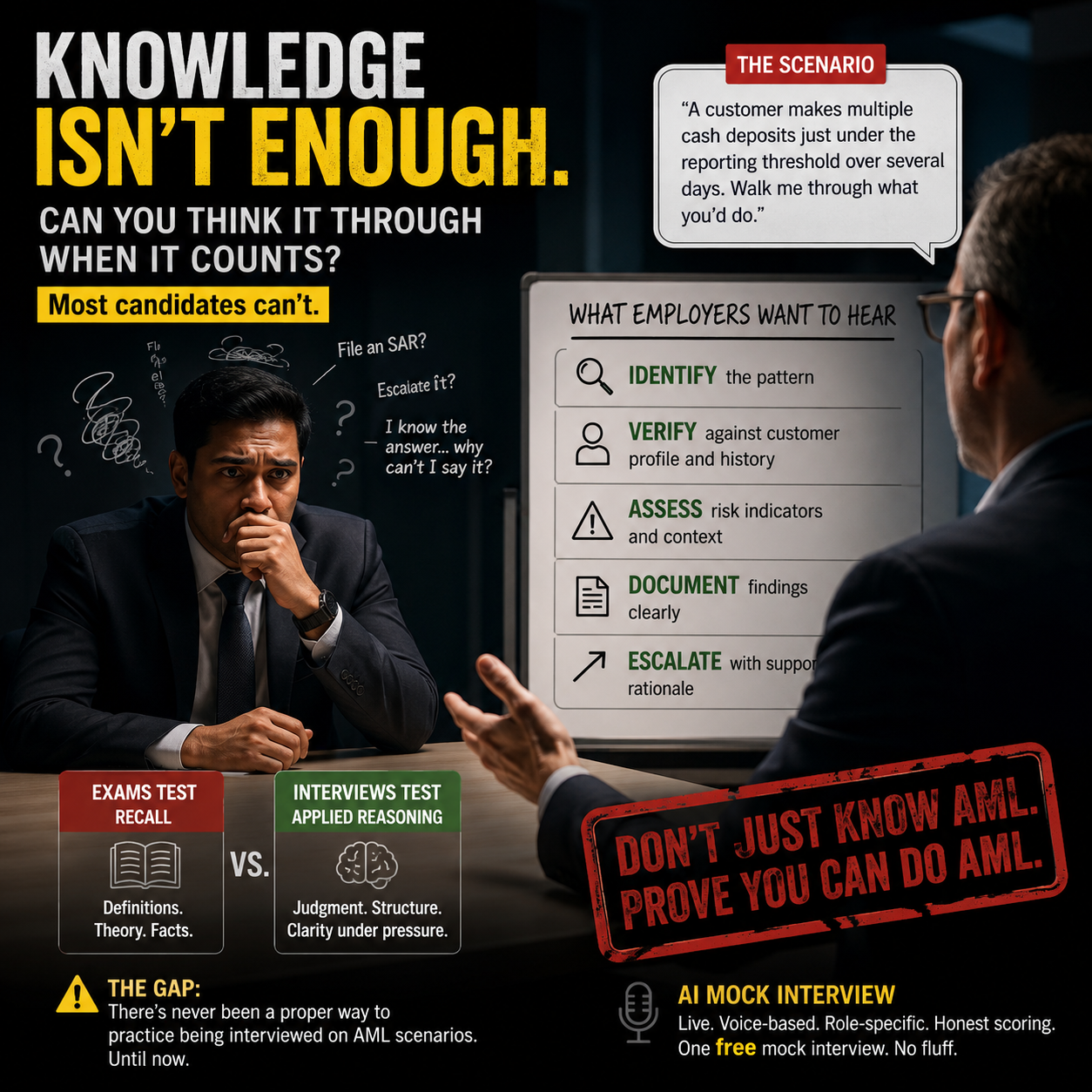
“A customer in your portfolio has been sending amounts just under your reporting threshold, to several different recipients, over the past two weeks. Walk me through what you’d actually do.”
And the room goes quiet.
Not because the question is unfair. It’s the kind of thing that happens on a real desk, in a real week. But what I hear back is almost always the same — a recitation of definitions. “That could be structuring.” “We’d need to escalate it.” Correct words, no actual reasoning. No walk-through of what they’d check first, what would confirm or rule out the concern, how they’d document it, or who they’d escalate it to and why. When I ask a simple follow-up — “which regulator would you actually be reporting this to, under this jurisdiction’s law?” — the answer is very often silence, or a guess.
The certification paradox
This isn’t a knock on CAMS or ICA. These certifications teach real, necessary knowledge — the frameworks, the terminology, the global standards. But a certification tests whether you know the material. An interview tests whether you can use it, under a bit of pressure, on a scenario you’ve never seen before, anchored to the specific laws of the market you’re actually applying to.
Those are two different skills. Most candidates have only ever practiced the first one.
And here’s the part that catches people off guard: employers already know this. Compliance teams are lean, and they’re almost never hiring someone they expect to spend six months training up. They want someone who can sit down on day one and already think like an investigator — someone who can ask “what’s the actual risk here, and what does our regulator expect me to do about it?” without needing to be walked through it.
A candidate who can define a Politically Exposed Person but can’t tell me what enhanced due diligence actually looks like in practice isn’t going to get the offer — no matter how many letters follow their name.
Why this gap exists
It’s not that candidates aren’t studying. It’s that there has never really been a place to practice being interviewed — to sit with a hard, realistic scenario question, answer it out loud under a bit of time pressure, and get told honestly where the reasoning fell apart. Study guides can teach you what a red flag is. They can’t simulate the moment someone asks you to apply it live, and watch you think.
So candidates walk into interviews having read everything and rehearsed nothing. And it shows immediately.
Why I built the AI Mock Interview
I wanted to build the thing I kept wishing candidates had access to before they sat across from me — a way to actually rehearse the moment that decides most interviews, not just the material behind it.

It starts with the choices that actually matter in a real job search not a one-size-fits-all quiz, but your target role, your target difficulty, and critically, the actual country and industry you’re applying into.

That jurisdiction piece matters more than most candidates realize. A structuring scenario in the UAE doesn’t get reported the same way, to the same regulator, under the same law, as one in the UK or Singapore. Before you even start, the platform grounds you in what’s actually true for the market you’re targeting the real regulator, the real legal framework, the typologies examiners in that country actually see.

Then the interview itself. The AI asks the question out loud, the same way a real interviewer would — and you answer by speaking, the same way you would in the room. No multiple choice. No definitions to recall. Just a scenario, and your reasoning.

Honest feedback, not a participation trophy
Here’s a real result from a test session I ran myself, on a moderately difficult crypto structuring scenario. I’m including it exactly as it came out — because the whole point of this tool only works if the feedback is honest.

A tool that tells everyone they did great isn’t useful. This one will tell you, plainly, when an answer didn’t hold together — and exactly where it fell apart, question by question.

And then, the part that actually matters most: not just what went wrong, but what to do about it — a concrete improvement plan, and a direct line from each specific weak spot to the course that closes it.

The gap between certified and ready is closeable
Every candidate I’ve described in this post was smart. Capable. Willing to put in the work. What they were missing wasn’t intelligence or effort — it was a place to rehearse the exact moment that decides most interviews, before it happens for real, with someone honest enough to tell them where the gaps actually are.
That’s what this is for.
Find out where your gaps actually are — before an employer does.
Free trial includes one full mock interview, scored honestly.
Start a mock interview