
Financial Crime & Career Risk
Is Every Job Offer You’ve Received This Year a Lie?
A 20-year fraud investigator got scammed by a job offer. Not tricked by a rookie mistake hunted by a system built specifically to catch people exactly like him. If it got him, what makes you think it won’t get you?
Somewhere right now, someone is opening a text message from an unknown number. It says they applied for a job. They didn’t. That single, disarming “Hello” is still the most effective weapon in a scammer’s arsenal , more effective than deepfakes, more effective than AI, more effective than anything else in the fraud playbook.
And it works on everyone. Including the people whose entire job is to catch fraud for a living.
The number that should stop you mid-scroll
In 2020, job seekers in the U.S. reported losing roughly $90 million to employment scams. By 2025, that number had crossed $600 million. Reports have nearly tripled. And every credible estimate agrees on one thing: fewer than one in ten victims ever reports it at all — which means the real number is almost certainly a multiple of what regulators can even see.
This isn’t a story about a few unlucky people falling for obvious cons. It’s a story about a criminal industry that has become faster, more convincing, and more automated than the systems built to stop it.
It’s not just costing money. It’s costing identities.
The end goal is rarely just the first payment. Once a scammer has a copy of your ID, your bank details, or your Social Security number, that data becomes raw material for something far more durable: a synthetic identity a fabricated person built from a real number and a fake name, capable of opening credit lines and passing checks for months before anyone notices.
And here’s the part almost nobody is talking about: the same tradecraft — stolen identities, fabricated credentials, remote-only interviews — is now being used by state-linked operatives to infiltrate real companies’ hiring pipelines. Prosecutors have spent the last year unwinding networks that placed fraudulent remote workers inside legitimate U.S. companies, funneling revenue toward sanctioned programs. The interview on the other side of your screen might not be who or what you think it is.
Eight patterns. One playbook.
After digging through dozens of first-hand accounts shared publicly by job seekers and recruiters, the same handful of tactics kept resurfacing — different company names, same script:
- The rotating shell posting — an identical job ad, emoji and all, reposted under a different real company every few days.
- The off-platform pivot — the conversation moves to WhatsApp or Signal before you’ve even finished reading the job description.
- The malware interview — a “software update” pop-up before a video call that turns out to be remote-access malware.
- The pay-to-proceed sequence — a “refundable” fee for interview scheduling, visas, or equipment that vanishes the moment you hesitate.
- The resume-rewrite referral — your application gets rejected, then conveniently “fixed” by a paid resume writer in the same network.
- The hijacked identity — a real employee’s name and photo, borrowed without consent, to make the scam look real.
- The application-fee funnel — a maze of redirects that ends in a “membership fee” just to apply at all.
- The task-based mule pipeline — small real payouts build trust, then your own bank account becomes the getaway car for someone else’s money.
None of these require a criminal mastermind. They require one thing: a job seeker who is tired, hopeful, and one application away from finally hearing “yes.”
The uncomfortable question
Here’s what should really keep you up at night: the fix scammers exploit best isn’t gullibility. It’s desperation the state of mind that sets in after your 400th application, when a message that says “we’d like to move forward” feels less like a red flag and more like relief.
Which means the real defense isn’t just learning to spot fake job posts. It’s shortening the amount of time you spend in that exposed, desperate state in the first place — showing up to fewer interviews, but the right interviews, prepared well enough that you can instantly tell when something about the conversation doesn’t add up.
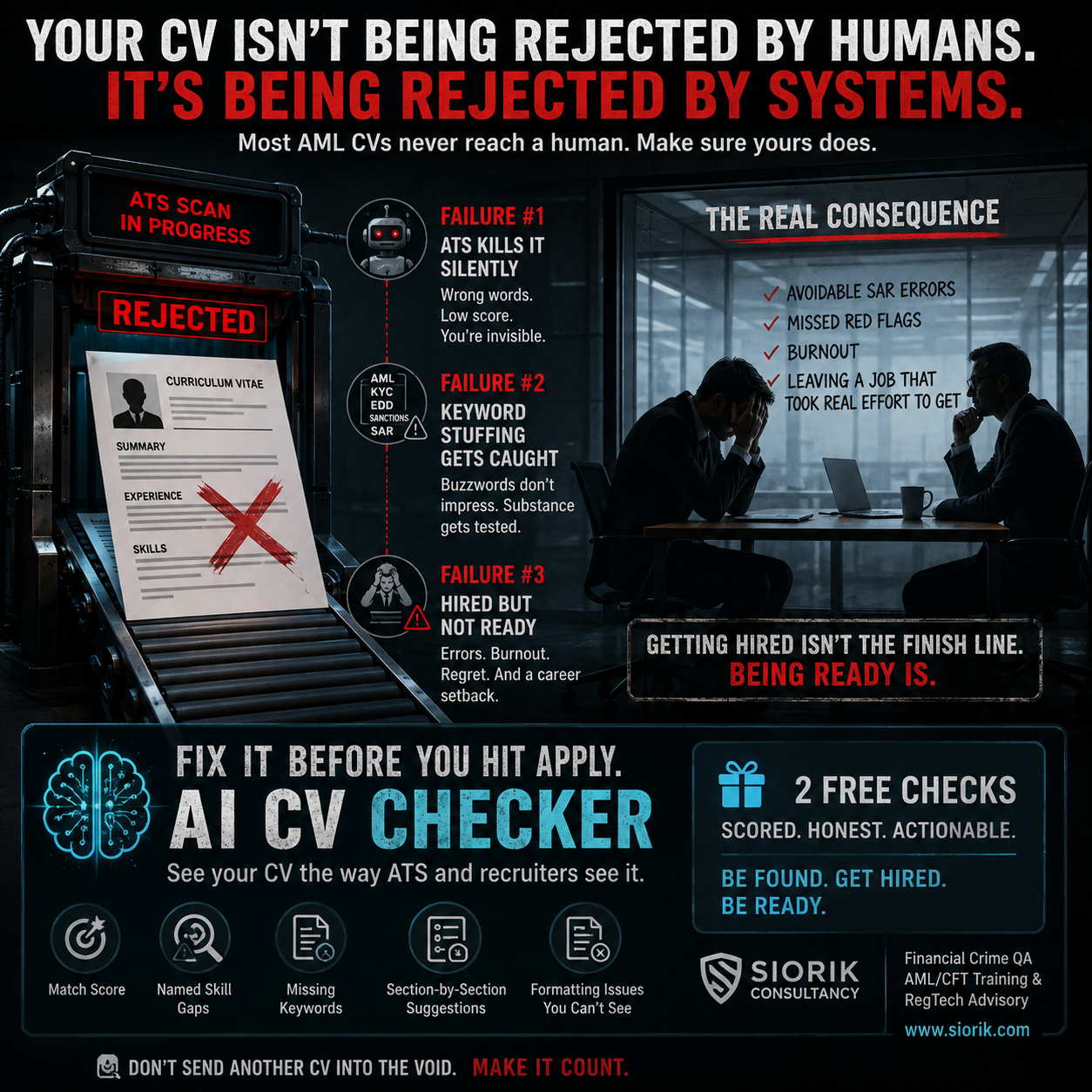
LearnWithSiorik.com helps AML/CFT and compliance professionals move through their job search faster and with more confidence — country-specific mock interviews grounded in real regulator names and reporting terminology, CV-to-job-description matching, and structured courses that close the exact skill gaps holding your applications back. The less time you spend job hunting, the less time you spend exposed.
Explore LearnWithSiorik.com →So — was it a lie?
Not every job offer you’ve received this year was fake. But somewhere in your inbox, right now, there’s very likely one that is dressed up convincingly enough that you’d only catch it on the third or fourth read. The people writing these scripts are not amateurs anymore. They are running an industry, complete with quotas, scripts, and in some documented cases, trafficking victims forced to send the very messages that convince you to trust them.
Understanding who is targeting you will not make the problem disappear. But it is the only thing that has ever helped anyone respond to it in time.
Published by Siorik Consultancy — Financial Crime QA, Advisory & Training. Read the full whitepaper above, or reach us at risksimplifier@siorik.com.