Two decades of hiring in AML and financial crime compliance taught me that most rejections happen before anyone reads a word you wrote.
I’ve spent more than twenty years in financial crime compliance, across banks and financial institutions in Nepal and the UAE. In that time, I’ve reviewed more CVs than I can count for AML, KYC, and compliance roles. And the vast majority of them share the same quiet, invisible flaw.
They were never written for the job they were sent to.
Same CV, sent to a transaction monitoring role, a KYC analyst role, and a compliance officer role, all in the same week. Same generic list of “responsibilities.” Same broad claim of “AML experience.” No mention of the actual regulator, the actual license type, or the actual day-to-day work the posting was asking for.
Most CVs never reach a human at all
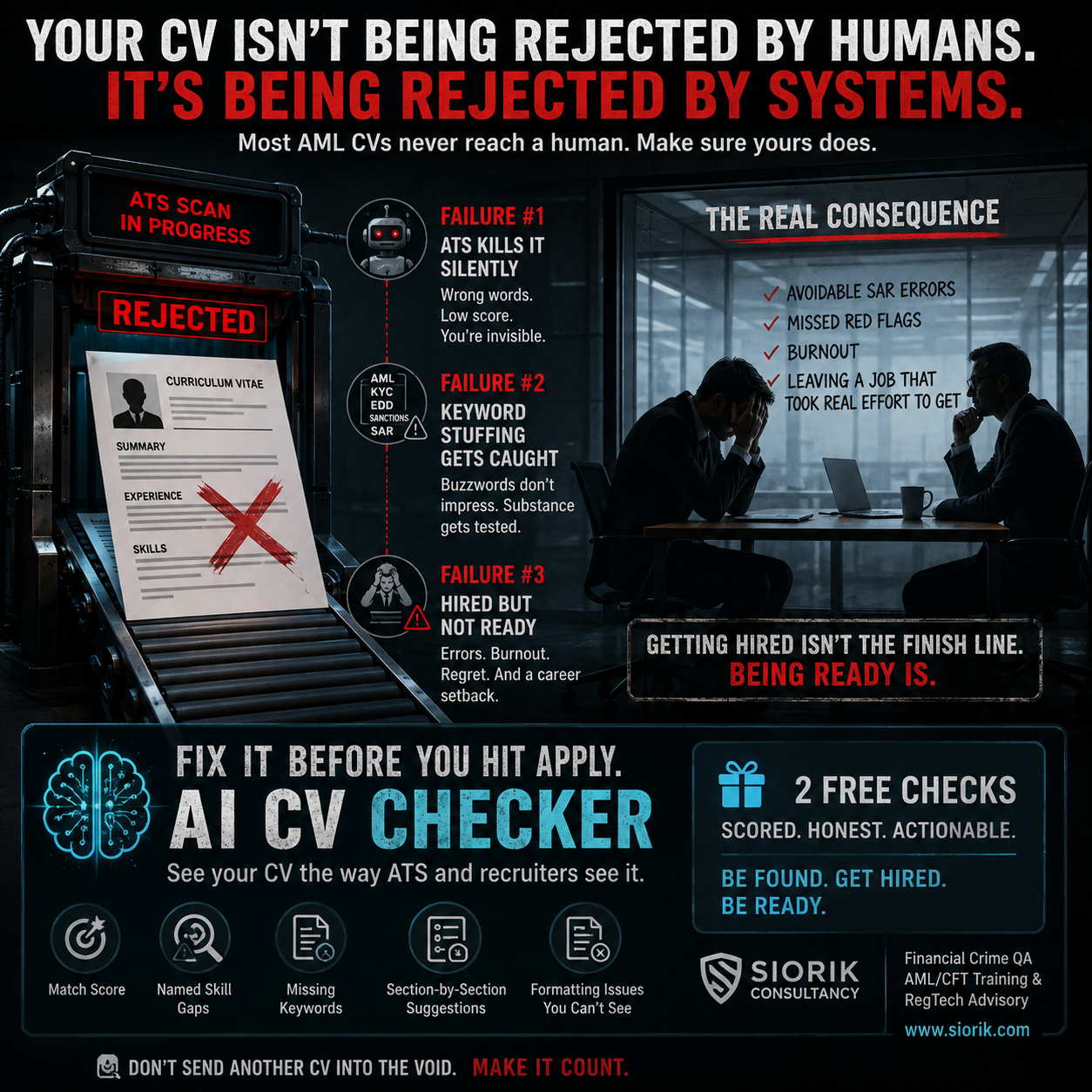
Here’s what a lot of candidates still don’t fully understand: at most institutions, your CV doesn’t land on my desk first. It lands in an ATS — an applicant tracking system — that scans for the specific keywords, qualifications, and phrases the job description actually asked for. If your CV doesn’t contain them, it often never surfaces for a human to read at all. Not because you weren’t qualified. Because the system never saw evidence that you were.
A candidate with real, relevant experience can lose to a weaker candidate simply because their CV was written in the wrong language — literally the wrong words, missing the exact terms the posting used.
The other failure mode: CVs built to fool the system, not fit the job
The opposite problem is just as common, and worse. I’ve seen CVs that were clearly generated or heavily “optimized” without the candidate actually reading the job description — padded with the right buzzwords, formatted to look impressive, but hollow the moment you ask a single follow-up question. Recruiters who’ve been doing this for a while can spot it almost immediately. A CV that lists “regulatory authorization” but can’t name which regulator, or claims “transaction monitoring expertise” with no actual case examples, doesn’t get further — it gets flagged.
And here’s the part candidates rarely think through: suppose it works. Suppose a CV like that actually gets you the interview, and somehow gets you the job. What happens next?
You’re now doing work you were never actually ready for. No organization is going to slow down and train you from scratch on skills your CV implied you already had. You’ll be making avoidable mistakes, missing what an experienced eye would catch immediately, and quietly falling behind while everyone assumes you already know this. That’s not a shortcut into the career. That’s a fast track into burnout — exhausted, underperforming, and eventually looking to leave a job you worked hard to get, for reasons that were entirely avoidable.
The honest path — building the real skills and tailoring your CV to genuinely reflect them — takes more effort up front. It also happens to be the only version of “getting the job” that doesn’t end in burnout six months later.
Why I built the AI CV Checker
I wanted candidates to be able to see their CV the way an ATS and an experienced recruiter actually see it — before they hit submit, not after a rejection they never got an explanation for.

It’s simple to use: paste the actual job description, upload your actual CV, and get an honest analysis of how the two really line up.

Honest scoring, not encouragement for its own sake
Here’s a real result from a test I ran myself, matching a genuine central-banking CV against a DIFC-based senior compliance role. I’m including it exactly as it came out.

A tool that only ever says “you’re a great fit” is worthless. This one will tell you plainly when you’re not — and, critically, exactly which specific gaps are the reason, so you know precisely what to fix instead of guessing.

It also shows you exactly what the ATS itself would see: the keywords that matched, and the ones that are conspicuously missing from your CV even if you actually have the underlying experience.

Then it walks through your CV section by section, with specific rewrite suggestions grounded in what the job description actually asked for — not generic “make it stronger” advice.

And finally, a direct check of whether your CV’s actual formatting would survive an ATS scan in the first place — tables, columns, and layouts that look sharp to a human eye but quietly break automated parsers.

Apply for the job you’re actually ready for
None of this is about discouraging you from applying. It’s about applying with your eyes open — knowing exactly where you stand, exactly what’s missing, and exactly what to do about it, instead of sending the same CV everywhere and hoping. And if the honest answer is “not yet,” that’s worth knowing now — before you spend months in a role you weren’t actually ready for, running on empty, wondering why it feels so hard.
See exactly how your CV stacks up before you hit submit.
Free trial includes two CV checks, scored honestly.
Check your CV