AI Tool That Tells Compliance Officers What Regulatory Changes Actually Mean for Their AML/CFT Programme
You don’t have a “finding regulatory updates” problem. You have a translation problem. A new FATF statement lands, an OFAC designation drops, or your local regulator issues revised guidance — and the real question is never “what happened?” It’s: “What do I need to change in my programme by Monday morning?” That translation step is where most AML/CFT programmes silently fall behind. This article introduces Compliance Radar — a purpose-built AI tool that reads regulatory developments and maps them directly to the pillars of your compliance programme, telling you exactly where to act.
◆
The Real Pain: Regulatory Change Isn’t Hard to Find — It’s Hard to Interpret
Let’s be honest about the daily reality. A typical compliance officer monitors FATF, OFAC, FinCEN, the FCA, the CBUAE, and a handful of local regulators. Finding updates isn’t the bottleneck — dozens of sources publish them constantly. The bottleneck is the cognitive labour that follows:
- Does this OFAC designation affect my sanctions screening lists, or is my vendor already covering it?
- Does this FATF mutual evaluation report change how I should sample transactions during QA?
- Does this CBUAE notice mean I need to update my risk assessment methodology — or just my training slides?
- Which specific paragraph of my AML/CFT policy is now potentially out of date?
This translation gap is where compliance programmes silently drift from proactive to reactive. Gaps don’t surface until a regulatory examination — by which point the cost is exponentially higher. The failure isn’t laziness; it’s the mathematical impossibility of one human processing hundreds of developments against every component of a live AML/CFT programme.
The result? Most compliance officers resort to scanning headlines over morning coffee, hoping they don’t miss something critical. That’s not a strategy — it’s a prayer.
Why Existing Solutions Still Leave You Exposed
None of these tools answer the question that actually matters: “What does this mean for my sanctions screening, my training programme, my QA sampling, and my risk assessment?”
◆
Introducing Compliance Radar: From Headlines to Actionable Programme Impact
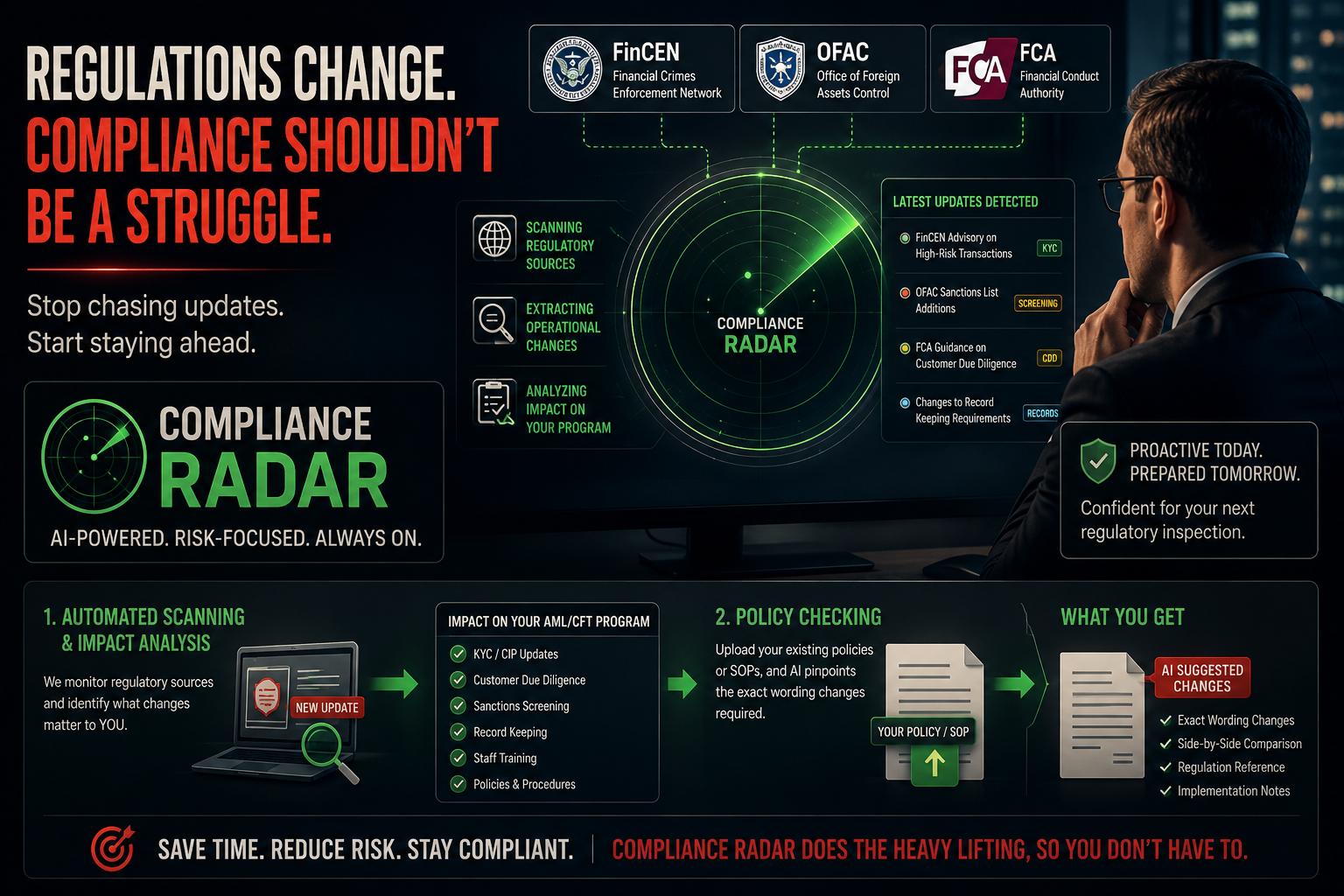
Compliance Radar is a focused AI tool built specifically for AML/CFT professionals. It doesn’t just summarise regulatory news — it analyses each development against the key pillars of your compliance programme and tells you where to act.
How It Works — Step by Step
Configure the regulators and bodies relevant to your programme — FATF, OFAC, CBUAE, FinCEN, FCA, or any combination.
The tool identifies developments since your last check, so you never re-read what you’ve already assessed.
Each development is mapped to impact areas: sanctions screening, training, QA sampling, policies, risk assessment. Each category includes a specific, actionable suggestion.
This is where it gets powerful. Upload your AML/CFT policy and the tool identifies which specific section may need updating based on the new regulatory development. Generic advice becomes organisation-specific guidance.
The differentiator isn’t AI summarisation — it’s structured compliance framework mapping. The tool uses a carefully engineered prompt architecture that maps every regulatory change against the five operational pillars of an AML/CFT programme. The output isn’t “here’s what happened” — it’s “here’s what you need to do about it, and where.”

Under the Hood — Without the Jargon
Compliance Radar is built using Python and Gradio for the interface, with LLM API integration for analysis. A few things worth knowing:
- It analyses, not just summarises. The underlying prompts are structured against a compliance programme framework — this is what produces categorised, actionable output instead of generic summaries.
- Data privacy by design. It runs through a direct API connection — your documents are not processed through public ChatGPT and are not stored or used for model training.
- Local model option. For organisations with strict data residency requirements, there’s an option to run on local models like Llama, keeping everything on-premises.
◆
Live Example: A CBUAE Notice Through Compliance Radar
Let’s make this concrete. Suppose the CBUAE issues a notice reinforcing requirements around beneficial ownership verification for legal arrangements, with updated thresholds and documentation expectations.
Here’s what a typical compliance officer does today: reads the notice, mentally maps it to their programme, makes a note to “review the policy,” and adds it to a task list that grows faster than it shrinks.
Here’s what Compliance Radar produces:
- Sanctions Screening: No direct impact identified — but flags that updated beneficial ownership data may improve screening accuracy against designated persons linked through complex structures.
- Training Programme: Recommends updating CDD/EDD training modules to reflect new documentation thresholds for legal arrangements. Suggests a targeted refresher within 30 days.
- QA Sampling: Advises increasing QA sampling on accounts involving trusts and legal arrangements for the next review cycle to assess analyst compliance with the updated requirements.
- Policies & Procedures: Identifies that Section 4.3 of the uploaded AML/CFT policy (CDD for Legal Persons and Arrangements) requires amendment to reflect the new thresholds.
- Risk Assessment: Suggests revisiting the inherent risk scoring for “legal arrangements” as a customer type, given the regulator’s increased focus.
“In ten minutes, I got the operational breakdown that would normally take me half a day of reading, cross-referencing, and drafting notes. And it pointed to a specific section of my policy I’d forgotten hadn’t been updated since 2023.”— Early tester, UAE-based MLRO
The Guardrails: What This Tool Is — and What It Isn’t
Let’s be direct about limitations. Intellectual honesty matters more than a sales pitch.
AI output requires human review. Compliance Radar assists your professional judgment — it does not replace it. Think of it like airbags in a car: they make driving significantly safer, but you still need to drive carefully. Every output should be reviewed by a qualified compliance professional before action is taken.
- Prototype, not production system. This is a working tool with real utility, but it’s a prototype. It will evolve based on user feedback and real-world testing.
- Data privacy is prioritised, not guaranteed. The API approach avoids public model training on your data, and local model deployment is available. But nothing connected to a network is 100% risk-free — and anyone who tells you otherwise is selling something.
- Not a regulatory database. It analyses developments you feed it or that it scans from configured sources. It’s not a replacement for comprehensive regulatory horizon-scanning subscriptions in heavily regulated contexts.
Use Compliance Radar as your first-pass analyst, not your final decision-maker. Let it do the heavy lifting on categorisation and impact mapping, then apply your expertise to validate, prioritise, and implement. This workflow consistently saves hours per week while improving coverage.
◆
The Bigger Picture: What This Means for Compliance Professionals
Here’s what building and using this tool reinforced:
AI won’t replace compliance officers. But compliance officers who learn to use AI effectively will consistently outperform those who don’t. The competitive advantage isn’t the tool itself — it’s the ability to ask the right questions and validate the outputs with professional expertise.
Building Compliance Radar forced a deeper, more structured examination of what an AML/CFT programme actually consists of — its pillars, interdependencies, and the precise points where regulatory changes create operational impact. The process of engineering prompts for AI clarified compliance thinking more than any conference session or webinar.
The Evolution of Compliance AI — and Where We Are Now
2020–2022: Rule-Based Alerts
RegTech focused on automating keyword-based alerts and document retrieval. Useful but still required extensive manual analysis downstream.
2023: LLM Summarisation Wave
ChatGPT and similar tools enabled fast summarisation, but outputs were generic, unstructured, and disconnected from specific compliance frameworks.
2024–2025: Framework-Mapped AI Analysis
Tools like Compliance Radar represent the next step: AI that doesn’t just read regulatory changes but analyses them against your programme’s actual operational structure. The output is categorised, specific, and actionable.
One person built this tool in days. A year ago, the same functionality would have required a development team, six months, and a significant budget. That’s not just a technology story — it’s a signal that individual compliance professionals can now build tools that solve their own problems.
◆
Frequently Asked Questions
Need Expert AML/CFT & RegTech Guidance?
17+ years across FATF, CBUAE, VARA & NRB. Visit our website for consultancy services tailored to your organization.
“Your compliance programme looks good on paper.
But will it survive a regulatory examination?”
What This Means for Compliance Professionals
There is an ongoing debate in our industry: will AI replace compliance officers? After building Compliance Radar , and using it in my own work , here is my honest answer: no, it will not. But here is what will happen: compliance professionals who learn to use AI as a tool will consistently outperform those who do not. Not because AI is smarter than an experienced compliance officer, but because it is faster at the parts of our job that consume time without requiring judgment , scanning, summarising, categorising, and drafting. The judgment, the interpretation, the “what does this actually mean for our programme” , that still requires a human mind with domain expertise.
Here is something I did not expect: building this tool forced me to think more clearly about my own compliance programme than I had in months. To teach an AI how to categorise regulatory impact, I had to articulate exactly what “impact” means , which categories matter, what a good suggestion looks like, how a change in sanctions policy differs from a change in CDD guidance in terms of operational response. That exercise , defining the problem precisely enough for a machine to help , sharpened my own thinking in ways that no amount of reading or conference attendance had done. The tool did not replace my expertise. It refined it.
And that leads to the real insight: the emerging skill in compliance is not knowing how to use AI. It is knowing what to ask for. Anyone can type a question into ChatGPT. The value lies in framing the right question , understanding your regulatory environment deeply enough to direct the technology toward problems that matter. A compliance officer who knows their programme inside out and can articulate precisely what they need from an AI tool will extract ten times more value than someone who treats it as a magic box. Domain expertise is not becoming less important in the age of AI. It is becoming the differentiator.
One final thought that I find genuinely exciting: I built Compliance Radar myself, as one person, in a matter of days. A year ago, this would have required a development team, a project budget, and months of build time. Today, a single compliance professional with domain knowledge and basic technical curiosity can build working tools that solve real operational problems. The barrier between “I have an idea” and “I have a working prototype” has essentially collapsed. If you are a compliance professional reading this and thinking “I wish I had a tool that could do X” , you are closer to building it than you think.
See It in Action
Compliance Radar is a working prototype , not a concept deck. Try it yourself and see how AI can transform your regulatory monitoring workflow.
We write about practical compliance and AI tools every week.